 Zapisz
 My first attempt at bagels happened on a Saturday morning when I was convinced homemade ones couldn't possibly rival the bakery down the street. Three hours later, with sourdough starter bubbling on my counter and onions caramelizing in a pan, I realized I'd been missing out on something special—that tangy, chewy texture that only time and fermentation can create. These sourdough onion bagels became my answer to store-bought, and honestly, the golden-brown moment when they emerge from the oven still feels like small magic.
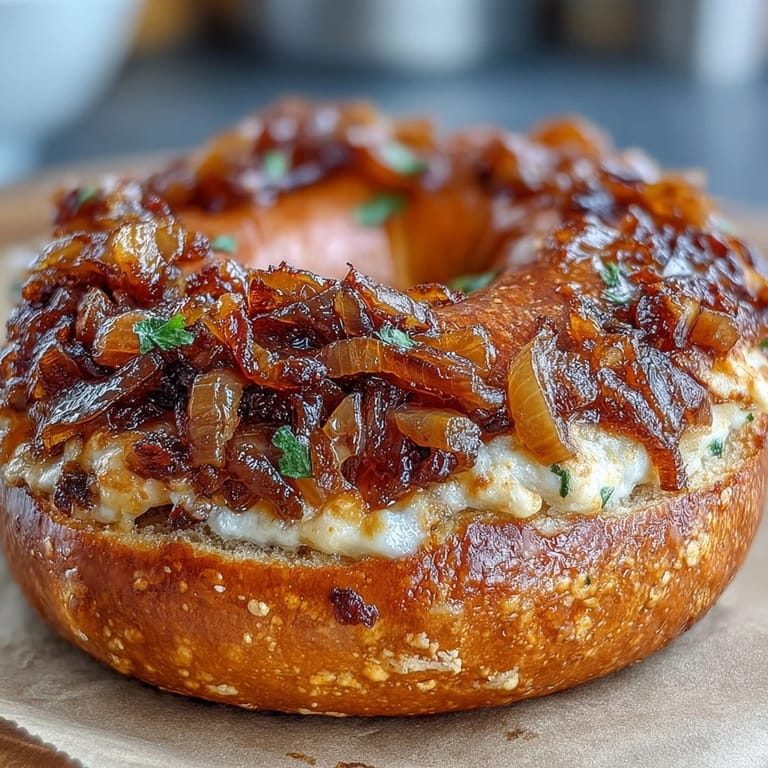
I made these for my partner on their birthday, and watching them bite into a still-warm bagel with cream cheese and smoked salmon felt like I'd finally cracked a code I'd been trying to solve for years. They closed their eyes for a second, and that's when I knew the overnight fermentation and all those stretch-and-folds had been worth every bit of patience.
Ingredients
- Active sourdough starter (100 g, 100% hydration): This is your leavening agent and flavor maker—it gives these bagels their characteristic tang and helps them rise without commercial yeast.
- Bread flour (400 g): Don't skimp here; the protein content is what creates that chewy texture bagels are famous for.
- Whole wheat flour (50 g): A small amount adds subtle nuttiness and depth without overpowering the tangy sourdough flavor.
- Sea salt (10 g for dough, plus 1/2 tsp for onions): Salt strengthens the gluten network and brings out the sourdough's natural complexity.
- Granulated sugar (25 g): A modest amount feeds the starter and slightly balances the sourness.
- Lukewarm water (240 ml): Temperature matters—too hot kills the starter, too cold slows fermentation.
- Large yellow onion (1, finely chopped): Yellow onions caramelize beautifully and turn almost sweet after sautéing, creating a topping that tastes like concentrated umami.
- Olive oil or unsalted butter (1 tbsp): Butter gives richer flavor, but olive oil works if that's what you have on hand.
- Barley malt syrup or honey (1 tbsp for boiling): This changes the bagel's flavor profile—barley malt is traditional and slightly earthy, while honey is more straightforward.
- Baking soda (1 tsp for boiling water): This alkaline ingredient creates the bagel's signature chewy crust and slight tang.
Tired of Takeout? 🥡
Get 10 meals you can make faster than delivery arrives. Seriously.
One email. No spam. Unsubscribe anytime.
Instructions
- Start your onion topping ahead:
- Heat oil or butter in a skillet over medium heat and add your chopped onions with salt. Let them cook slowly for 8–10 minutes, stirring occasionally—you want them golden and soft, almost melting into themselves. This caramelization is where the magic happens, so don't rush it.
- Bring your dough together:
- In a large bowl, combine your bubbly active sourdough starter with both flours, salt, sugar, and lukewarm water. Mix until everything is incorporated into a rough, shaggy mass—it will look a bit messy, and that's exactly right. Don't worry about smoothness yet.
- Develop the dough with gentle kneading:
- Knead for 8–10 minutes by hand or machine until the dough becomes smooth, elastic, and slightly tacky. You should feel it transform from rough to silky, which means the gluten is developing properly. Cover the bowl and let it rest at room temperature.
- Perform stretch-and-folds for strength:
- Over the next 2 hours, every 30 minutes, gently stretch one side of the dough up and fold it over itself, rotating the bowl and repeating four times. This builds strength without aggressive kneading and is what sourdough bakers do to create structure. After 4 hours total, the dough should look fuller and more cohesive.
- Develop flavor overnight in the cold:
- Cover the bowl and refrigerate for 8–12 hours—this is where the sourdough's tangy flavor develops and the dough becomes easier to shape. The cold also slows fermentation, giving you more control over timing the next day.
- Shape each bagel with intention:
- Turn your dough onto a lightly floured surface and divide it into 8 equal pieces. Shape each into a smooth ball, then use your thumb to poke a hole in the center and gently stretch it into a bagel shape with about a 2-inch hole—the hole should look intentional, not accidental. If the dough resists, let it rest for a few minutes and try again.
- Give them a final rise:
- Place shaped bagels on a parchment-lined baking sheet, cover them loosely, and let them proof at room temperature for 1–2 hours until they look slightly puffy but still hold their shape. They shouldn't be airy like bread—bagels should feel substantial.
- Prepare your boiling bath:
- While bagels finish proofing, preheat your oven to 220°C (425°F) and bring a large pot of water to a rolling boil with barley malt syrup (or honey) and baking soda stirred in. The baking soda will make the water cloudy and create that signature bagel crust texture.
- Boil for the perfect crust:
- Working one or two at a time, gently drop bagels into the boiling water and let them cook for exactly 1 minute per side—this creates the chewy crust without making them dense. Use a slotted spoon to turn and remove them, returning them to the baking sheet still damp.
- Top while moisture is your friend:
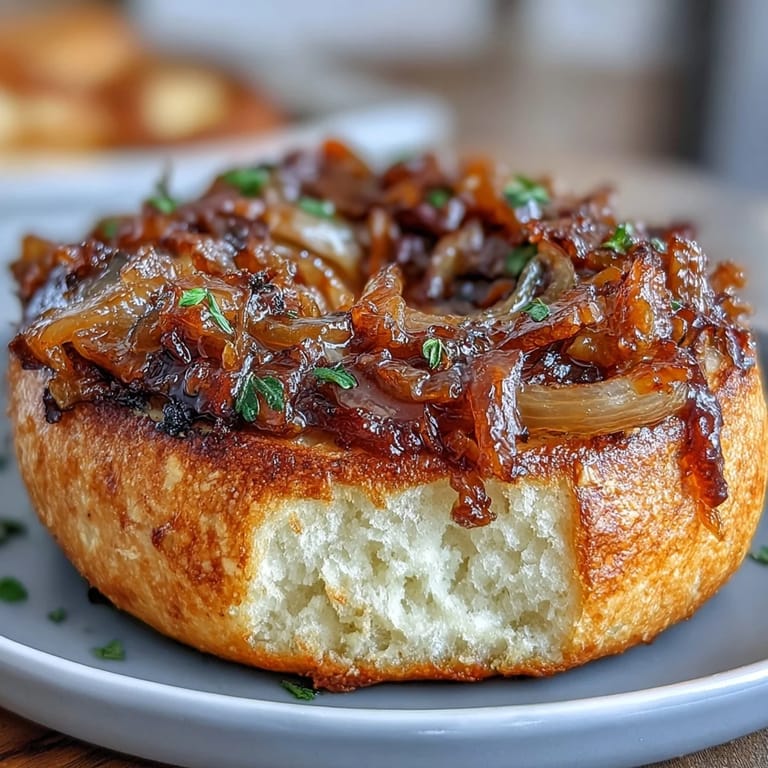
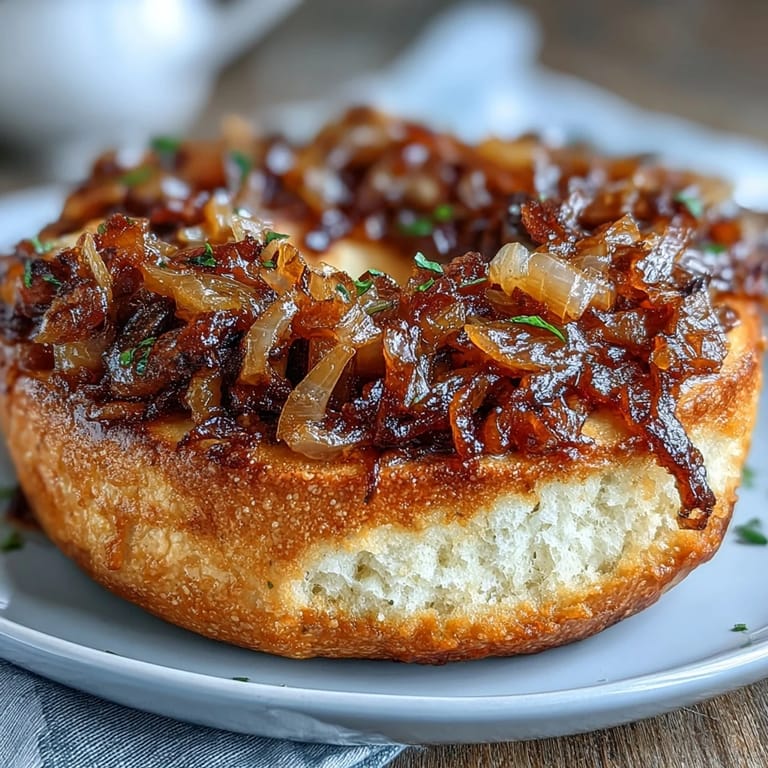
- While bagels are still slightly damp from boiling, press your cooled sautéed onions generously onto the tops, letting them stick naturally. The moisture helps everything adhere, so don't wait until they're completely dry.
- Bake until golden and set:
- Bake for 20–25 minutes until the bagels are deep golden brown and sound hollow when tapped on the bottom. You want them cooked through but not dried out—the crust should be crispy-chewy, not hard.
- Cool before slicing:
- Transfer bagels to a wire rack and let them cool for at least 15 minutes before slicing—this lets the crumb set properly and makes slicing cleaner.
 Zapisz
 There's something deeply satisfying about slicing into a bagel you made yourself, steam rising from the warm interior, and tasting both the tang of fermentation and the sweetness of caramelized onions in one bite. My friends stopped asking where I'd bought them after the second round.
Why Sourdough Makes Everything Better
Using sourdough starter instead of commercial yeast gives these bagels a flavor you simply cannot rush. The wild yeast and bacteria work slowly during that long cold fermentation, creating organic acids that make the dough more digestible and give it that distinctive tangy note that defines a truly great bagel. Plus, if you have a starter living on your counter, you're already halfway to bagel success.
The Science of the Boil
That minute in boiling water does something almost miraculous—it gelatinizes the outside of the bagel while it's still cold on the inside, which means the exterior sets into a chewy crust while the crumb stays tender. The barley malt syrup adds subtle sweetness and helps brown the surface, while the baking soda raises the pH and encourages that signature dark color and slight chewiness. It's a small step that makes all the difference between homemade and amateur.
Making Them Your Own
Once you master the basic formula, these bagels become a canvas for your own flavors and moods. I've topped them with everything from crispy bacon bits mixed into the onions to everything seasoning sprinkled on before baking, and each version feels like a small discovery. The base dough is forgiving enough that you can play around without losing that essential sourdough chew.
- Try mixing poppy seeds or sesame seeds into the onion topping for extra texture and nuttiness.
- If you want less tang, use your starter at a younger stage before it peaks, or reduce the overnight fermentation to 6–8 hours.
- These freeze beautifully after baking—wrap them individually and reheat from frozen in the oven for fresh-tasting bagels weeks later.
 Zapisz
 Every time I pull a batch of these from the oven, I'm reminded that the best recipes are the ones that teach you something about patience and flavor along the way. These bagels are worth the wait.
Najczęściej zadawane pytania dotyczące przepisów
- → Jak długo trwa fermentacja ciasta na zakwasie?
Fermentacja powinna trwać od 8 do 12 godzin, co pozwala na rozwinięcie aromatu i elastyczności ciasta.
- → Dlaczego gotuje się bagels przed pieczeniem?
Gotowanie nadaje bagels charakterystyczną skórkę, utrzymuje wilgotność ciasta i poprawia jego strukturę.
- → Jak uzyskać słodki smak cebuli na wierzchu?
Cebulę należy podsmażyć na oliwie lub maśle z odrobiną soli, aż stanie się miękka i złocista, co wydobywa naturalną słodycz.
- → Czy można dodać inne dodatki na bagels?
Tak, posypka z maku, sezamu lub innych ziaren doskonale komponuje się z cebulowym wierzchem.
- → Jakie mąki wykorzystać do tego pieczywa?
Najlepiej użyć mąki chlebowej z dodatkiem pełnoziarnistej, co zapewnia odpowiednią strukturę i smak.